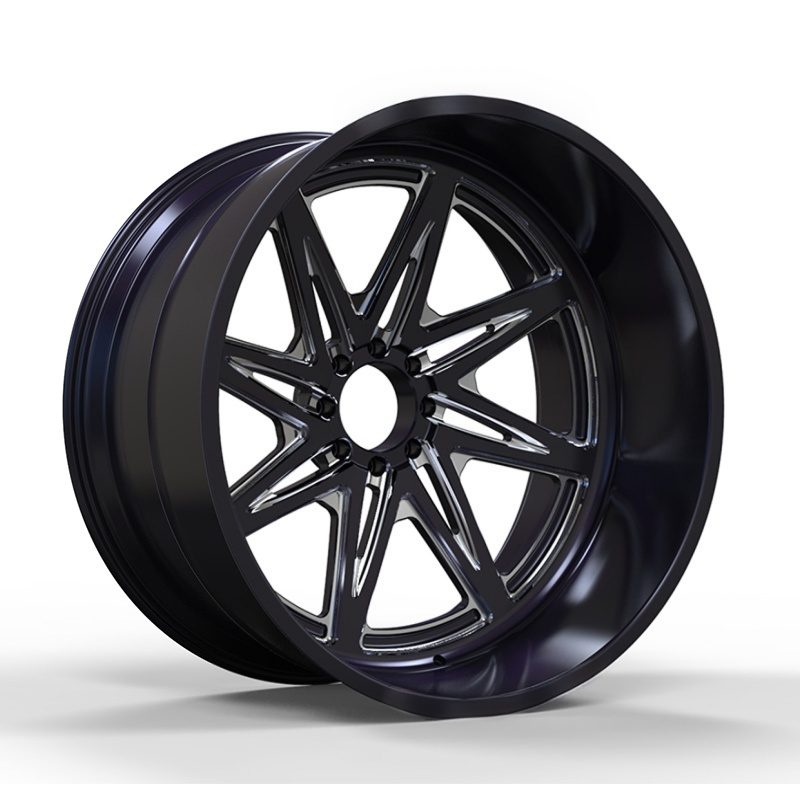
From billet to finished monoblock: how a single forged part is made, where it beats multi-piece construction, and what a brand can realistically customise inside a production programme.
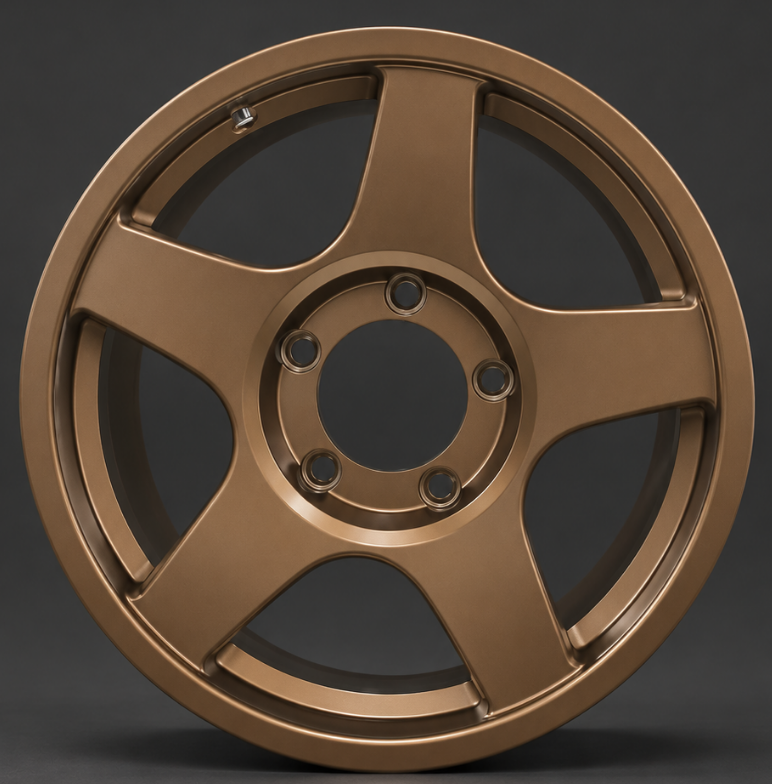
A 1 piece forged wheel is a single continuous aluminium component: barrel, spoke face, hub and bead seats are forged and machined as one solid part, with no bolts, no sealed joints and no separate lip. That one structural fact explains almost everything else about the product, including how it is manufactured, how it behaves under load, how much mass it carries at a given strength level, and which design changes are genuinely available to a buyer.
Most of the confusion around the term is not about the definition but about what the definition buys. A casting can be called one piece because it comes out of a mould as one body. A flow formed wheel can be called one piece because it starts from a single disc. Neither is forged in the sense that matters to a performance buyer, where a solid billet of heat-treated aluminium is pressed into a dense, directional grain structure before a single cut is taken.
For B2B buyers, the practical question is narrower than the marketing language. Does a monoblock forged design deliver enough structural margin, enough design freedom and enough visual differentiation at a weight and production cost your market will accept? The sections below answer that from the manufacturing floor outward, covering the process sequence, the benefits that survive contact with real roads, and the customisation that is still open once a programme moves past the sample stage.
What a 1 Piece Forged Wheel Actually Is
In a monoblock design, the entire wheel is one metallurgical body. There is no fastener circle holding a face to a barrel, so there is no interface to loosen, no sealant to age, and no torque sequence to maintain at every service interval. Load travels from the tyre bead through the flange, into the barrel, up through the spokes and into the hub as a continuous path through the same piece of metal.
That continuity is why the format dominates motorsport categories where inspection time is short and failure consequences are high. A scrutineer can look at a monoblock wheel and know there is nothing to check for joint fatigue. A dealer fitting a set to a customer car does not have to explain a break-in torque procedure or a re-torque interval, which removes an entire category of after-sales dispute.
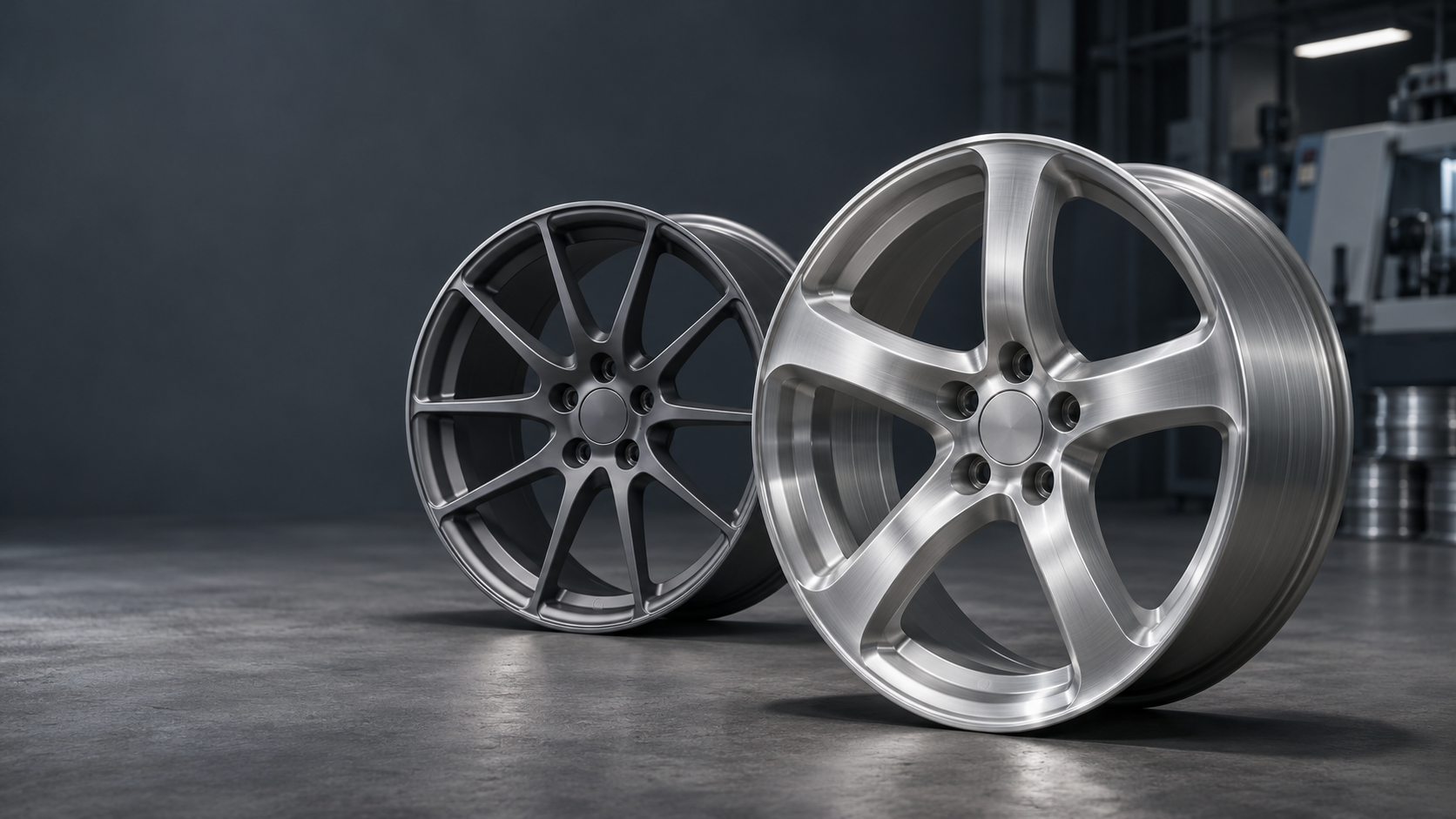
The trade-off is design latitude. In a two-piece or three-piece wheel, the face and the barrel are separate parts, so a brand can pair one face design with several barrel profiles and lip depths, and can replace a damaged outer lip without scrapping the whole wheel. A monoblock wheel must be designed as one geometry from the start. Everything the buyer wants, from brake clearance to concave depth, has to be resolved inside a single forged envelope. Our 1 part forged wheel range exists precisely to work inside that constraint.
The 1 Piece Forged Wheels Manufacturing Process, Step by Step
A 1 piece forged wheels build begins with a billet, not a mould. The billet is sawn to a weight calculated from the finished geometry, heated into the forging window for the alloy in use, and pressed so that the material flows into the rough shape of the wheel rather than being cut out of a solid block. The pressing step is what closes internal porosity and aligns the grain with the direction of load.
The barrel is then flow formed, a rotary process that thins and lengthens the rim section under controlled pressure while the material stays work-hardened and continuous. After that the part goes through solution heat treatment and artificial ageing to reach the T6 condition, which is the point at which the alloy gains its combination of tensile strength and elongation. Only then does CNC machining start.
Machining is where the wheel becomes a product. The spoke windows are cut, the hub face is faced, the bead seats and flanges are turned, the lug holes are drilled on the correct bolt pattern, and the centre bore is brought to its final tolerance. Every one of those operations removes material that the forging gave structural value to, which is why the sequence matters: a wheel machined from a casting behaves nothing like one machined from a forging, even when the two look identical on a shelf.
| Stage | What Happens | Why It Matters to the Buyer |
|---|---|---|
| Billet selection | 6061-T6 or 7075 aluminium billet cut to calculated weight | Alloy choice sets the strength-to-weight ceiling for the whole programme |
| Forging | Heated billet pressed into rough wheel form | Closes porosity and aligns grain with load direction |
| Flow forming | Barrel spun and thinned under controlled pressure | Produces a thin, strong rim section without a weld |
| Heat treatment | Solution treatment followed by artificial ageing to T6 | Balances tensile strength against elongation under impact |
| CNC machining | Spoke windows, hub face, bead seats, PCD and centre bore | Determines runout, balance and fitment accuracy |
| Finishing | Machined face, brushed, polished, painted, anodised or plated | Sets the product tier and the maintenance story for the end user |
| Inspection | Radial and lateral runout, balance, load and impact testing | The data a distributor needs when a customer complains about vibration |
Where Monoblock Construction Changes Structural Behaviour
In a multi-piece wheel, the joint between face and barrel is a designed discontinuity. It is fastened, sealed and torqued, and it introduces a stiffness change exactly where bending moments peak during cornering and kerb strikes. A monoblock wheel has no such discontinuity: stiffness transitions gradually from hub to spoke to barrel, so the whole part shares the load instead of concentrating it at a bolt circle.
That is also why a forged monoblock tends to feel more predictable at the limit. When a wheel deforms progressively, the driver receives a progressive signal through the steering. When a bolted joint begins to move, the signal is abrupt. For a track-oriented customer the difference is measurable in lap-time consistency; for a road customer it is the difference between a wheel that stays true and one that develops a slow vibration after a season of poor surfaces.
The same logic applies to repairability in reverse. A bent monoblock cannot be re-lipped. It can sometimes be straightened within a defined tolerance, but a wheel with a cracked or heavily deformed barrel is a scrap part. Buyers who run low-profile tyres on bad roads should understand that trade before choosing the format, because the customer conversation after the damage is always harder than the one before the order.
What monoblock construction removes from the product:
- No fastener circle to re-torque, so no joint-preload maintenance in service
- No sealant between halves, so no slow-leak path at the joint
- No lip replacement, which is the one serviceability advantage multi-piece keeps
There is a second-order effect that matters to anyone specifying a wheel for a heavy or fast vehicle. A bolted wheel is a stack of parts with different thermal expansion rates, and the joint is the place where that difference accumulates. Under sustained braking heat, a monoblock part expands as one body with one expansion coefficient, which keeps the bead seat round and the runout stable as the wheel heats and cools through a session.
Weight, Unsprung Mass and Rotational Inertia
Forging does not automatically produce a light wheel, and that is the most common misunderstanding in this category. A forged wheel is light because the material properties allow thinner sections to carry the same load, not because forging is intrinsically weightless. A badly designed forged monoblock can weigh the same as a good flow formed wheel and cost considerably more to make.
Where the format earns its place is in the mass distribution. Material is placed where the bending load demands it, in the spoke roots and the hub transition, and removed where it does not, in the spoke windows and the barrel midsection. Reducing mass at the outer edge of the wheel has a disproportionate effect on rotational inertia, because inertia scales with the square of the radius. A kilogram saved at the rim lip is worth far more than a kilogram saved at the hub.
Unsprung mass is the second effect, and it is the one drivers notice on ordinary roads rather than on a circuit. Less unsprung mass lets the damper control the wheel more precisely over broken surfaces, which improves contact-patch consistency and reduces the feeling that the car skips over ridges. On a heavy electric vehicle the benefit is larger still, because the same wheel has to manage more static load while the chassis is trying to isolate more mass.
Benefits That Show Up After Fitment
The benefits that matter commercially are the ones a dealer can demonstrate and a customer can feel within a week. They are rarely the headline numbers on a specification sheet; they are the absence of problems that cheaper wheels create after a few thousand kilometres of real use.
- Stable geometry over time. A forging that has been correctly heat treated resists the slow distortion that shows up as a vibration at a specific speed band, which is the single most common reason a wheel comes back.
- Predictable brake clearance. Because the spoke profile is designed around a specific caliper envelope rather than adapted from a generic casting, clearance is checked in CAD before the first tool is cut.
- Repeatable finish. Machined faces cut on the same programme produce the same highlight line across a batch, which protects a brand's visual identity when a customer buys a replacement wheel two seasons later.
- Fewer installation variables. One part, one torque value at the lug nuts, no assembly step, which shortens fitting time and reduces the chance of a technician error on a busy Saturday.
- A cleaner story for the end user. There is no break-in period, no re-torque reminder, and no explanation of how a three-piece wheel is assembled, which makes the product easier to sell in markets where the buyer is new to forged wheels.
Custom Design Options Inside a Production Programme
Customisation is where buyers most often overestimate what a monoblock programme can absorb. A one-piece wheel is a fixed geometry: change the spoke window and you change the load path; change the concave depth and you change brake clearance and caliper sweep. The variables that remain genuinely free are the ones that do not alter the structural envelope.
- Width and diameter combinations. Once the forging tool exists, a family of widths can be machined from it, which is how a brand builds a range from one investment.
- Offset and centre bore. These are machining parameters, so a fitment can be tailored to a vehicle platform without new forging tooling, provided the hub thickness stays within the design window.
- Bolt pattern and lug seat. Drilling is a separate operation, so a programme can serve several vehicle platforms from one face design as long as the hub area allows it.
- Finish. Machined, brushed, polished, matte, anodised, painted or plated, including two-tone combinations and diamond-cut highlights on the spoke edges.
- Detail work. Centre cap design, engraved logo, decorative rings, valve stem finish and hidden hardware, all of which change perceived value without touching structural design.
Anything beyond that list is a new tool. A new spoke count, a deeper concave, a different window shape or a change in spoke thickness all require new forging dies and a new machining programme, and buyers should expect a design cycle rather than a quotation turnaround. Our forged wheel customization service separates those two tiers clearly, because pretending a new design is a colour change is how programmes fall behind schedule.
Design Limits: Where a One-Piece Wheel Stops Working
The first limit is brake clearance. Deep concave geometry pushes the spoke face inward, toward the caliper, and the clearance that looked generous in a 2D drawing can disappear once the barrel and the wheel arch are modelled together. On vehicles with large multi-piston calipers, the spoke profile usually has to be flattened near the hub, which reduces visually available depth.
The second limit is load rating. A 22-inch monoblock designed for a two-tonne SUV cannot share a forging envelope with a 19-inch wheel for a compact coupe, because the required section thicknesses differ substantially. Carrying a load rating that is stamped and defensible is what separates a wheel engineered for a vehicle class from a wheel adapted to fit one.
The third limit is the tyre interface. Bead seat geometry, flange height and rim well depth all have to suit the tyre the customer actually intends to run, including run-flat and high-load variants. A wheel that is dimensionally correct but optimised for a different tyre construction can produce a bead-seating problem that no amount of balancing will solve.
Quality Control Checks Worth Auditing at the Factory
When a buyer visits a factory, the useful questions are about data, not equipment. Ask which standard the wheel is tested against, and then ask to see the report for the exact size and load rating you intend to order. A laboratory that can run SAE J2530, JWL, TUV or ECE R124 test sequences but has no recent report for your part is a laboratory you cannot audit.
The second useful check is process control on the heat treatment. The T6 condition is not a label, it is a recorded time and temperature profile per batch. Ask how that record is linked to a serial number, because that linkage is what makes a claim traceable months later.
The fourth check happens on your side, after the container arrives. Unpack a minimum of one wheel per carton size, put a dial gauge on the bead seat, spin it on a balancer, and compare the runout and balance numbers with the inspection report that shipped with the batch. If those two sets of numbers disagree, you have found a process problem before your dealer found it in front of a customer, and the conversation with the factory is factual rather than emotional.
A fifth check is documentation. A serious forged wheel programme should be able to produce, for any serial number, the billet heat number, the forging date, the heat treatment batch, the machining programme revision and the final inspection result. Buyers rarely ask for that until the first claim, and by then the answer is either in a database or it does not exist. Building the requirement into the purchase order costs nothing and changes how the factory treats your order.
How RETA Approaches 1 Piece Forged Wheels
RETA has been building forged wheels in Ningbo since the brand was established in 2012, with the company itself founded in 2009. The plant covers 12,000 square metres with more than 100 staff, and 7075 forged aluminium wheels are in volume production and delivered to overseas customers alongside the more widely used 6061-T6 programmes.
The quality system runs on ISO 9001, ISO 14001, ISO 45001 and IATF 16949, with national high-tech enterprise status granted in 2021. Internal test limits are set tighter than the SAE, JWL and PCT requirements we design to, and we add 30-degree and 90-degree impact and deformation tests because those are the failure modes that appear in real use rather than in a laboratory cycle.
On the commercial side, the minimum order is one set of four wheels, standard sizes run in roughly 7 to 15 working days, and fully custom designs take about 25 to 35 working days. Programmes usually start from the SSD 1P series and move into a private design once a brand has confirmed which fitments sell.
We exhibit at SEMA, where the brand received the 2023 Best Innovative Wheel Brand Award, and that show is also where most of our long-term OEM and ODM relationships began. The pattern is consistent: a buyer arrives with a fitment list and a finish direction, and leaves with a specification that can be quoted against.
Frequently Asked Questions
Q1. Is a 1 piece forged wheel stronger than a two-piece wheel?
Strength depends on the design and the material, not the part count. What a monoblock removes is the joint, and the joint is where fatigue and loosening originate. For the same mass, a well-designed one-piece forging usually gives a more uniform stress distribution, which is why it holds geometry longer in hard use.
Q2. Can a one-piece wheel be repaired if the lip is damaged?
Only within narrow limits. Minor deformation can sometimes be corrected by a specialist within a defined tolerance, but a cracked or heavily bent barrel means the wheel is replaced. Buyers running very low profile tyres on poor roads should factor that into the specification rather than discover it after the first pothole.
Q3. Does a deeper concave design reduce brake clearance?
Yes, and that is the most common design conflict in this format. Concave depth moves the spoke face inward toward the caliper, so on vehicles with large multi-piston brakes the profile near the hub usually has to be flattened. The clearance has to be verified against the actual caliper and wheel arch, not estimated.
Q4. What can be changed without new forging tooling?
Width, offset, centre bore, bolt pattern, finish, centre cap and engraving are all machining or finishing variables. Spoke count, window geometry, spoke thickness and concave depth are not: those change the forging and require a new tool, which is the boundary every brand should establish before promising a product line to a market.
Q5. Are forged monoblock wheels suitable for heavy SUVs and electric vehicles?
They are, provided the wheel is designed for that load class from the beginning. A large diameter monoblock for a heavy vehicle needs greater section thickness at the hub and spoke roots than a wheel for a light coupe, and the load rating has to be validated rather than assumed from the diameter.
Send us your vehicle list, load target and finish direction, and we will specify the 1 piece forged wheels your programme needs, with the tooling boundary stated up front.
Browse the Forged Wheel Range Send Fitment Data